
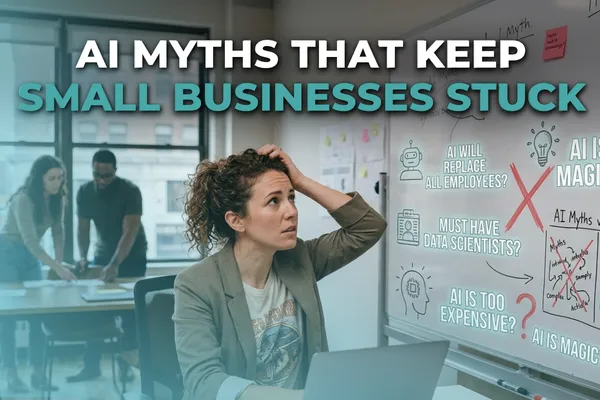
Top 5 AI Myths That Keep Small Businesses Stuck
Debunking Common Misconceptions About AI
Most business owners have heard it by now: "You should be using AI." But hearing it and actually feeling confident about it are two very different things.
And honestly, that gap makes sense.
There's a lot of confusing information out there. AI gets talked about in ways that make it sound expensive, complicated, or built for companies with a hundred employees and a full tech team. But the reality is, AI has become far more accessible and practical than most people think.
From automating repetitive tasks to improving customer communication and marketing, businesses of all sizes are using it in ways that save real time and create real growth.
So before you decide AI isn't for your business, let's clear up the myths that might be holding you back.
Myth #1: "AI Is Only for Big Companies"
Here's something worth thinking about as a small business owner: your time is one of your most valuable assets.
Big companies have large teams. You don't. Which means every hour you spend on something that could be automated is an hour you're not spending growing your business, serving clients, or getting ahead of the competition.
AI levels the playing field. A local clinic, agency, or service business can now use tools that were once only available to enterprise companies, without the enterprise price tag or the enterprise headcount.
Small businesses are actually some of the biggest beneficiaries of AI because the efficiency gains matter more when your team is lean.
Myth #2: "AI Is Too Expensive"
Some of the most impactful AI tools cost less than you'd expect, and when you put them to work in the right areas, they end up saving you far more than they cost.
One of our clients is a great example. After we identified the highest-leverage areas in their business, the AI tools we put in place reduced their operational costs by 10 times what they were paying for the tools themselves. That's not a rounding error. That's a real return.
The key isn't just buying AI tools. It's knowing where to use them so you actually feel the difference.
Myth #3: "AI Will Replace Human Creativity"
This one comes up a lot, and it's easy to understand why. People worry that AI-generated content will feel generic, or that leaning on AI means giving up the thing that makes their brand feel human.
But here's what we're actually seeing with our clients.
We're currently working with a business owner who is building a suite of new AI and automation tools to sell to others in his industry. What started as a business idea became something much bigger once he started using AI to think through the possibilities.
As we were working together, he kept saying how much more creative he'd gotten. His vision kept expanding. Things he thought were out of reach started feeling completely doable. AI wasn't narrowing his thinking, it was opening it up.
That's what happens when you use AI as a thinking partner instead of just a content machine. The strategy, the personality, the relationships? That's still all you. AI just removes the friction so you can go further with it.
Myth #4: "AI Is Too Complicated"
A lot of business owners assume they need to be technical to use AI. They picture complex systems, coding, and a steep learning curve. We get it, because even our own team has hit those walls.
Not long ago, we were working on a project and ran into a roadblock with a system we couldn't figure out. We'd tried a few things. Nothing worked. It started to feel like one of those problems that was just going to eat up hours of our time.
So we turned to an AI tool and asked it to walk us through possible solutions. It gave us options. We kept working with it, narrowing things down based on what we were actually trying to accomplish. Eventually we landed on the right path, and the AI laid out the exact step-by-step process to get there.
What felt complicated and stuck became a clear, manageable set of actions. We went from spinning our wheels to moving forward in a fraction of the time.
That's the reality of how AI works in practice. You don't need to be a developer. You just need to know how to ask the right questions.
Myth #5: "AI Makes Businesses Feel Less Personal"
This is probably the most common concern we hear from service-based businesses. They're worried that automation will make their customer interactions feel cold or scripted.
One of our clients felt exactly that way. They were hesitant to use AI for customer communication because they'd worked hard to build real relationships with their clients and didn't want to lose that.
So we showed them a different approach. Instead of setting up generic automated responses, we programmed the AI to respond with empathy, to acknowledge what the customer was feeling, and to communicate in a way that was actually related to them.
The result? Their customers didn't feel like they were talking to a bot. They felt heard. Satisfaction went up, not down.
When AI is set up thoughtfully, it doesn't remove the human element. It protects it by making sure every customer gets a response that's timely, relevant, and genuinely caring, even when you're not available to send it yourself.
Why Small Businesses Should Pay Attention
Businesses embracing AI are moving faster in marketing, customer communication, lead generation, and daily operations. The ones avoiding it are often working harder than they need to while their competition gains ground.
The goal was never to replace people. It's to remove the unnecessary manual work so the right people can focus on what actually matters.
Frequently Asked Questions About AI for Small Businesses
Is AI actually useful for small businesses or just a trend?
AI is very much practical for small businesses right now. Tools exist today that help with customer communication, marketing, scheduling, content creation, and operational efficiency. Businesses using them are saving real time and reducing real costs.
How much does it cost to start using AI in my business?
It depends on the tools, but many of the most impactful ones are surprisingly affordable. Some have free plans or low monthly costs. The bigger question is where to use them, because the right placement is what turns a small investment into significant savings.
Do I need technical skills to use AI tools?
No. Most modern AI tools are built for everyday users. If you can navigate social media or send emails, you can use most AI platforms. The learning curve is much smaller than people expect.
Will AI make my business feel less personal to my customers?
Not if it's set up correctly. When AI is programmed thoughtfully, with the right tone, empathy, and context, customers often have better experiences because they get faster, more consistent responses.
Where should a small business start with AI?
Start with your biggest time drain. What tasks eat up your hours but don't require deep human judgment? That's usually the best place to introduce AI first. Common starting points are customer follow-ups, content creation, and appointment scheduling.
Can AI really save my business money?
Yes, and often significantly. When applied to the right areas, AI can reduce operational costs far beyond what the tools themselves cost. The key is being strategic about where you put it to work.
Final Thoughts
AI isn't reserved for big tech companies anymore. It's a practical, accessible tool that helps real businesses save time, serve customers better, and grow without burning out.
The biggest obstacle isn't technology. It's the myths.
Starting small is completely fine. Even one or two well-placed AI tools can change how your business feels to run on a daily basis.
Curious where AI could make the biggest difference for you? We help businesses find practical solutions for marketing, automation, customer communication, and workflow efficiency. Reach out and let's have a real conversation about what's possible for your business.